
A Great Question
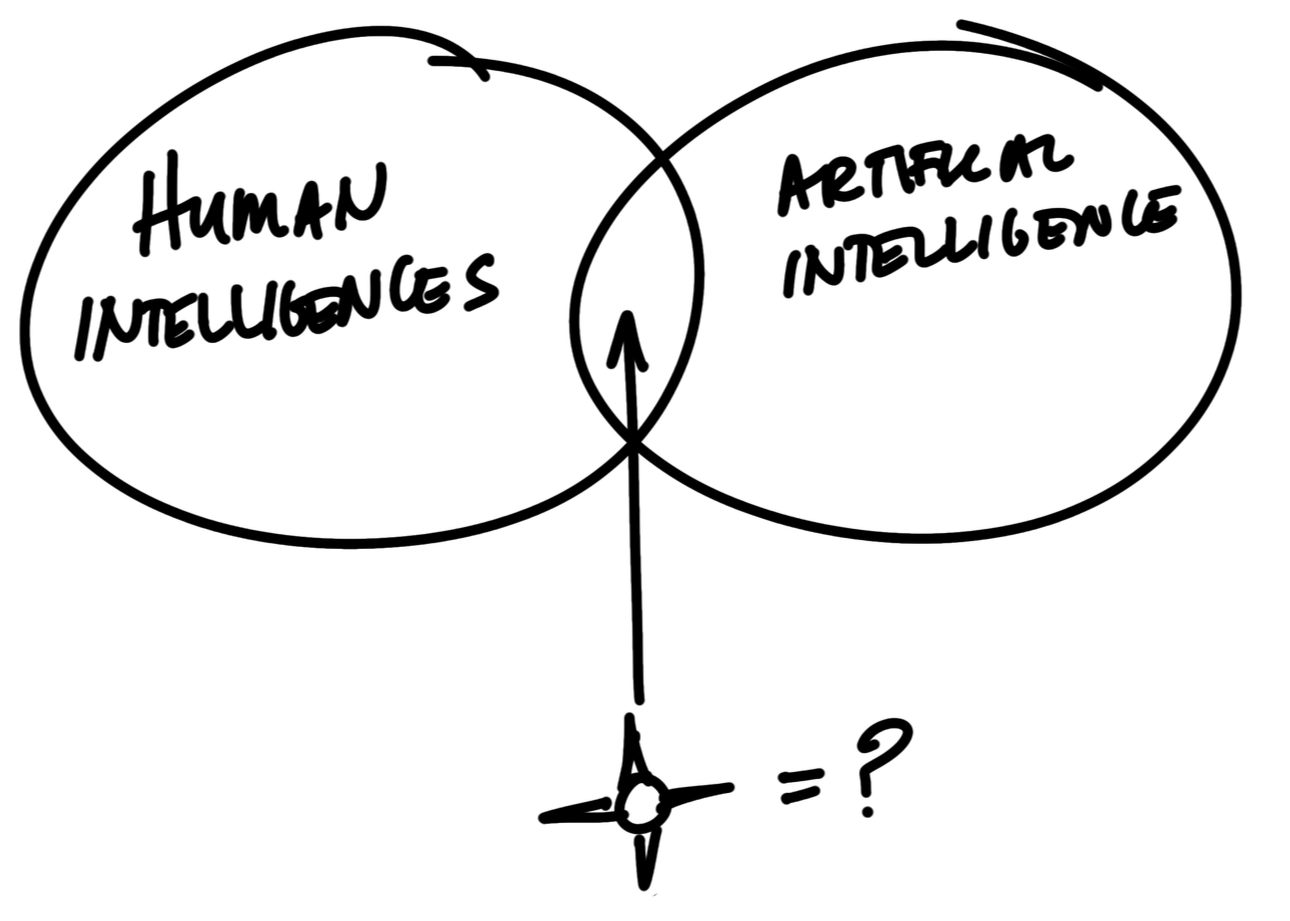
My publisher asked:
When might people reach for their compass, versus (or alongside) AI?
That’s a question for any tool these days: its role in the human-computer dynamic, and vice versa.
For example, as I write this, the news is full of OpenAI's releasing reams of mathematical proofs. This usurped (perhaps) the excitement of human discovery embodied in a favorite film around Boston (where I live), Good Will Hunting, where crowds ran across the MIT lawn (the scene of many of my own study sessions long ago) to see the human solution to a mathematics challenge on a chalkboard (fun fact: filmed at my husband's undergrad alma mater, the University of Toronto).
So, I’m exploring it.
The Definition of Intelligence
First, I got curious about the technical definition of “intelligence.”
Merriam-Webster’s is:
the ability to learn or understand things or to deal with new or difficult situations.
An academically rigorous definition comes from the Mainstream Science on Intelligence consensus statement (1994) drafted by Linda Gottfredson and signed by 52 leading researchers in intelligence and cognitive psychology:
"…The ability to reason, plan, solve problems, think abstractly, comprehend complex ideas, learn quickly and learn from experience….comprehending our surroundings—'catching on,' 'making sense' of things, or 'figuring out' what to do."
So, a reason the compass questions arise so often alongside specific advice in practices from leadership and parenting to engineering and design may be that these situations and decisions are ultimately yours—and the practices prompt your intelligence to figure out what to do.
Or Rather, Intelligences
In the spirit of abundance, I love the notion of multiple intelligences. Howard Gardners’ are one famous set.
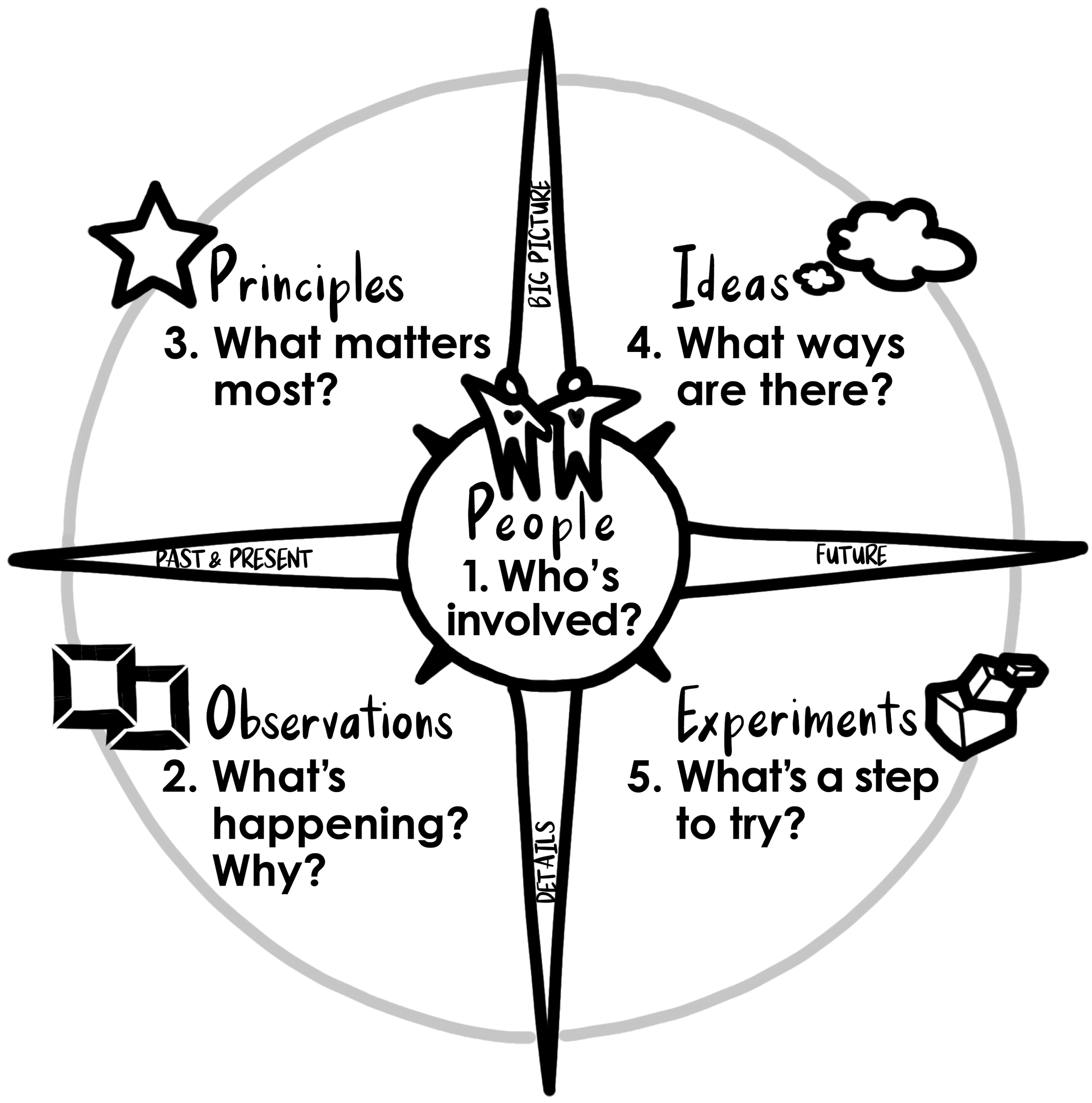
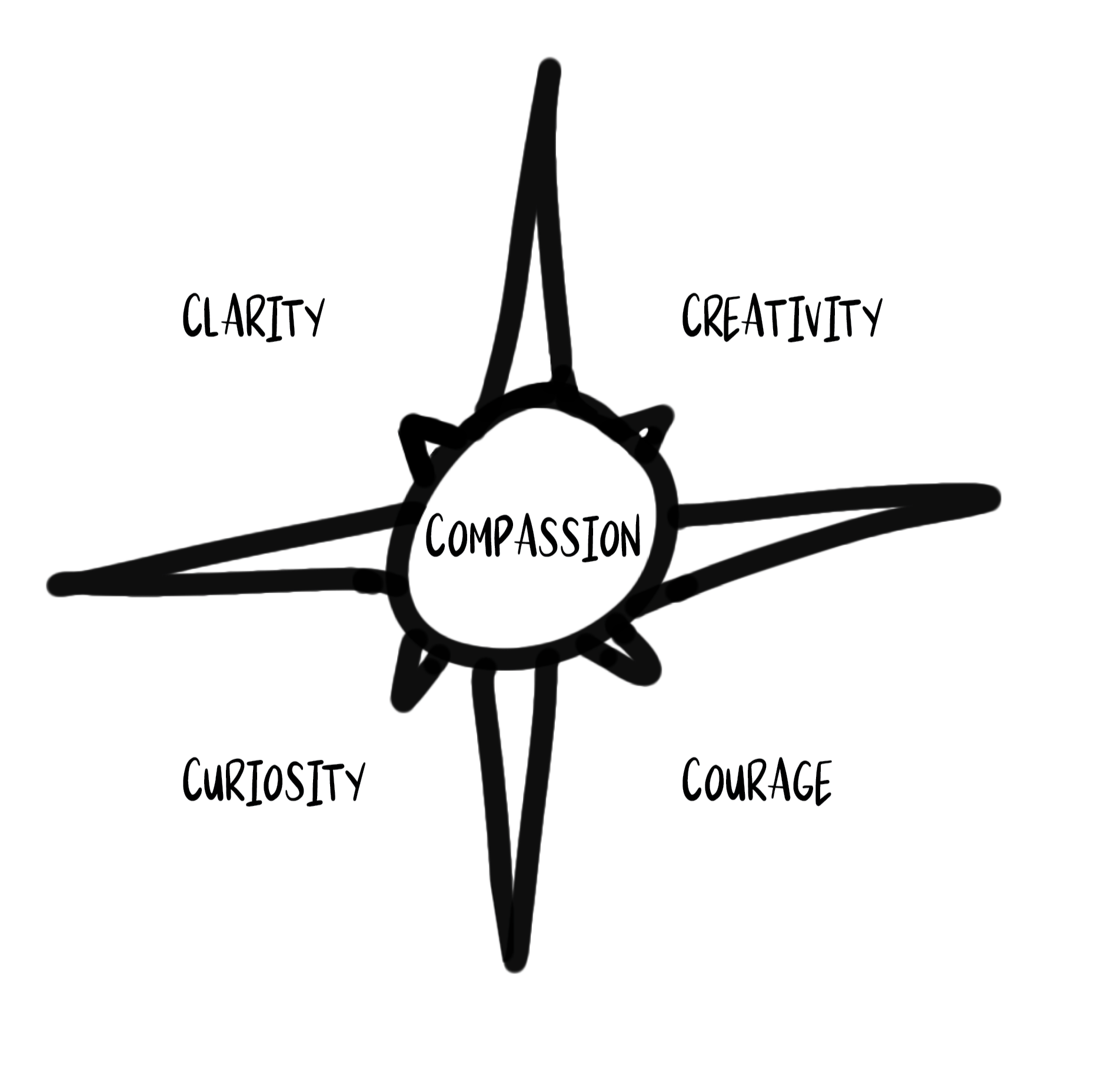
Many pieces of the “intelligence” definitions above align surprisingly well with our compass capacities—to understand what’s happening for everyone involved in a situation, what matters most, and ways forward—with our compassionate, curious, critical, creative, and practical/courageous “thinking.”
And, again in the spirit of abundance, we have multiple seats of, and sensors serving, these intelligences.
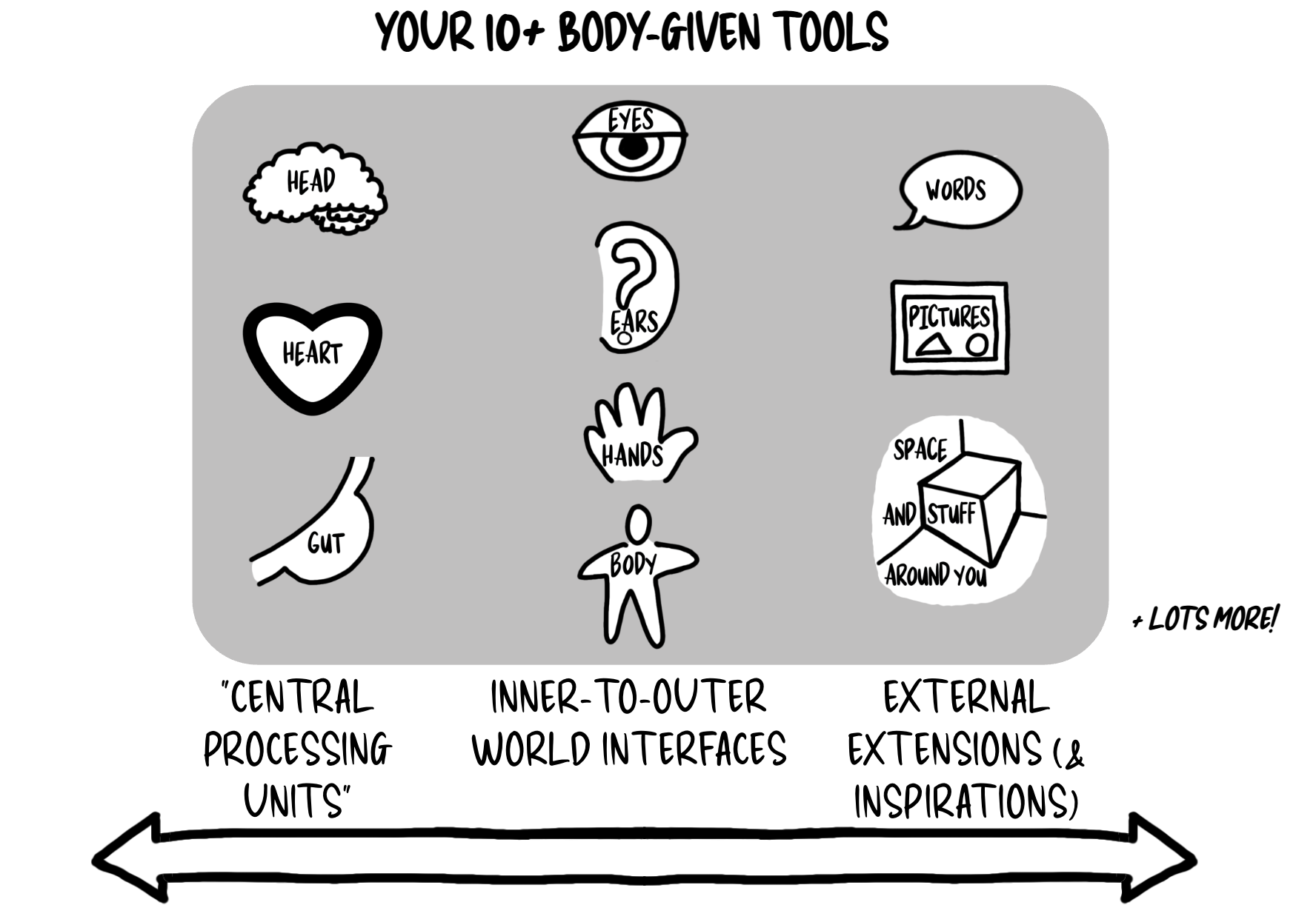
For example, beyond our brains, our bodies’ responses play a role in:
our encoding and recognition of patterns in our experience—our “gut” intelligence (studied by Antonio Damasio among others)
our discernment of emotions and capacity for compassion, aspects of our “emotional intelligence” (pioneered by Daniel Goleman).
What May Matter Most
So, one answer to my publisher’s question is:
When we navigate new, difficult, and/or important situations—staples of modern life and work—we can reach for our compass questions and cues to prompt our fuller, human intelligences, instead of, before, or alongside reaching for AI.
Tap your intelligences, first.
Maximize your own natural resources before tapping into global-natural-resource-depleting AI.
You can prompt yourself with the tools above: explore one or more of the five questions about your situation, using more of your punctuation marks and human tools to find more possibilities.
In small-to-medium groups, try using multi-modal methods (like sticky-then-speak) to hear, see, and work with everyone’s thoughts.When a very large number of people are involved in a situation, and you’ve collected everyone’s observations, principles, and ideas, AI can help synthesize these for all to see to understand the challenge and navigate forward together. Be sure to probe it for contradictory or underrepresented views it may have glossed over before considering those results.
Of course, you can add AI's web-search capacity—but keep your Compass handy.
Asking AI can inform your compass; but remember it draws only on others’ past, recorded experiences, choices, and outcomes.Again, ultimately, this situation—and choices—belong to you and others involved.
Having Compassed on your own first will allow you to describe your people, observations, and principles in your specific situation to build a better prompt for ideas, more specific to your situation. And again, think of your punctuation as you interrogate AI's suggestions. Nudge it for commas: What else? Question it: What are your sources & certainty?
Let those ideas spark new ideas—or observations and questions for you.
Whether it’s your idea or AI’s you start with, don’t assume it’ll work. Regardless of what has happened in your/the past, every step we take is subject to the unknowns of the future. Try small experiments first—and keep that Compass handy to respond.
Here, humans choosing to use AI are doing what matters most—including directing AI to critical new questions that build on and re-fuel their own maxed-out discoveries, and checking what comes out.
While I am not a mathematician, reading the news stories, I feel for the many mathematicians whose livelihoods are at stake. I also notice that a sliver of hope people point to involves mathematicians—humans—continuing to do “what matters most” above.
We’re all navigating the new situation of choosing when and how to use AI. My thoughts are ever-evolving, so please share yours!