
When I was teaching high school, it seemed like every month I’d be in the copy room or hanging with my teacher colleagues and learning about the latest cheating scandal. Students seemed to be spending their energy and creative capacity trying to skirt the system that clearly wasn’t working for them, rather than actually learning.
Exasperated teachers, too, used their energy to devise byzantine gimmicks and answer keys, threaten grades, suspensions, and even college recommendation letters, all with the purpose of preventing students from cheating.
So one day I asked a colleague: “Why don’t you just design an uncheatable assessment?” Seems like a crazy idea, right? But in this culture of surveillance, where AI has turned teachers into police who try to catch students getting away with something instead of actually teaching, and where students see school as a series of boxes to be checked and hoops to be jumped through, I knew there had to be a better way.
So I wrote my book about authentic learning, Storytelling With Purpose, which took the ideas I’d used successfully in my classroom for decades, and created a handbook and guide for educators about how to use purpose-driven assignments to elevate learning. The chapter on assessment was so popular that I turned it into an online course and workshop named after that hallway conversation so many years ago: Uncheatable Assessments.
But why would students cheat in the first place? It’s so disrespectful of our effort and expertise, and the hundreds of hours we spend as educators crafting the perfect lesson on topics we love and know are important. The answer, it turns out, is multifaceted, but has to do more with agency and purpose than your subject or how well you lecture. The key, backed by tons of research, is that students–like you and me–are, in fact, curious and want to have an impact, if only we’d let them.
The secret to designing an uncheatable assessment is to leverage students’ innate sense of curiosity, personal connection, and agency to foster a culture of integrity that disincentivizes the desire to cheat in the first place. Then, have students create original artifacts through the application of knowledge from your class, rather than rote memorization and the expectation for every student to have the same answer at the same time. This one-of-a-kind artifact cannot be made by any other student or AI chatbot because it bears the unique signature of each student’s choices, aesthetic, and personality.
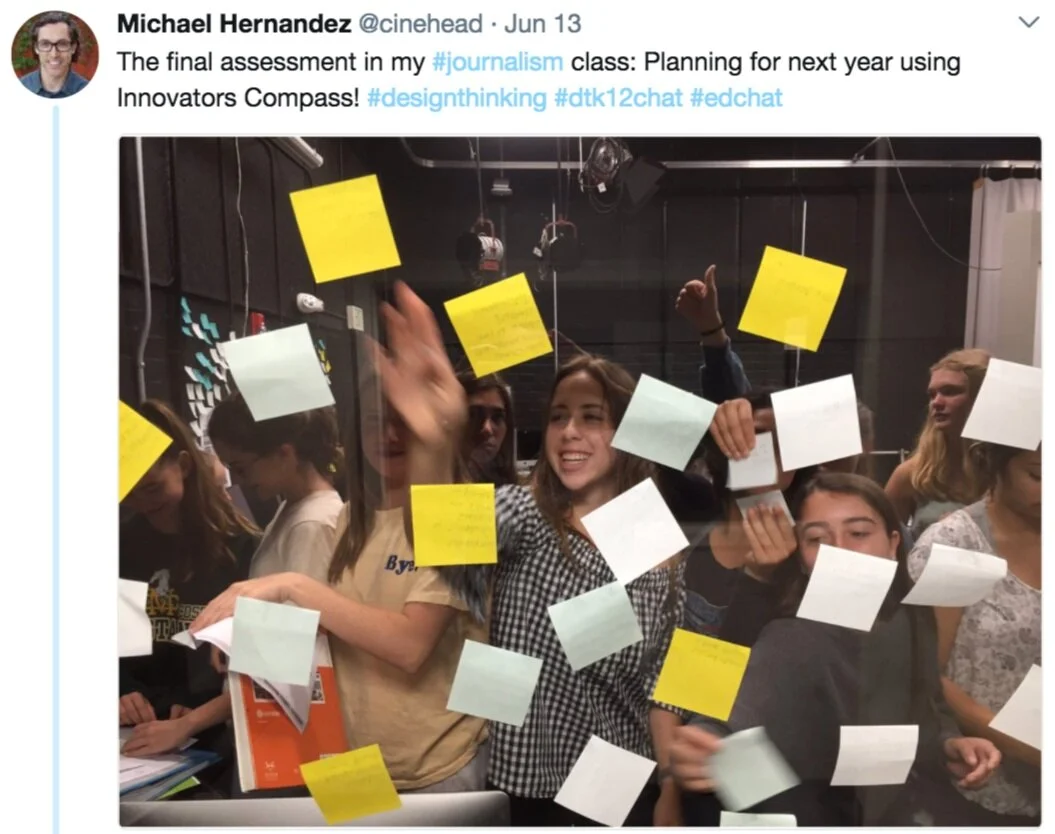
For years, I’d used the Innovators’ Compass to make this kind of learning experience possible. My journalism students would use the tool at the beginning of an assignment to design future plans and topics, and further along in the assignment in order to solve challenges they faced, like how to improve audience engagement, how to give peer evaluations, or what topics they should cover. I also used it as a reflection tool–a kind of assessment–to help them see where they’ve been, and where they want to go in the future.
But here’s why Innovators’ Compass is ultimately most powerful for teaching. The secret to getting students to show up physically and intellectually to school, and to do so with integrity, is to give them agency over their learning, as a partner in designing their own academic journey, and ask them to consider their work in the context of others and as a way to help themselves become personally better.
Students are no different than you or me. We all just want to follow our passions, to know that our work and effort matter, and to be valued and trusted to do good work, even if it’s messy and even if we make mistakes sometimes (or a lot).
In the end, Uncheatable Assessments are about process, human-centered experiences connected to real life, and the many ways we can measure what truly counts when no one is looking, and there is no grade on the line. Innovators’ Compass is an easy way to unlock the potential of your students and your classroom, to help you get unstuck in your thinking, and to discover what matters most for your students and the world beyond the classroom.