
When my publisher suggested explicitly aligning Innovators’ Compass and its complementary tools with “decisions”—an essential but often implicit part of all the challenges I’ve navigated, led, and coached—I knew I couldn’t make that decision without exploring it!
I’m deeply grateful to three remarkable young women who reached out to contribute a bit of their time this summer. They formed a formidable team that not only helped ease my mind about fitting this research in, but stretched my mind with their approaches and insights.
A Fresh, Far-Reaching Look Across the Fields of Decision-Making and Problem-Solving
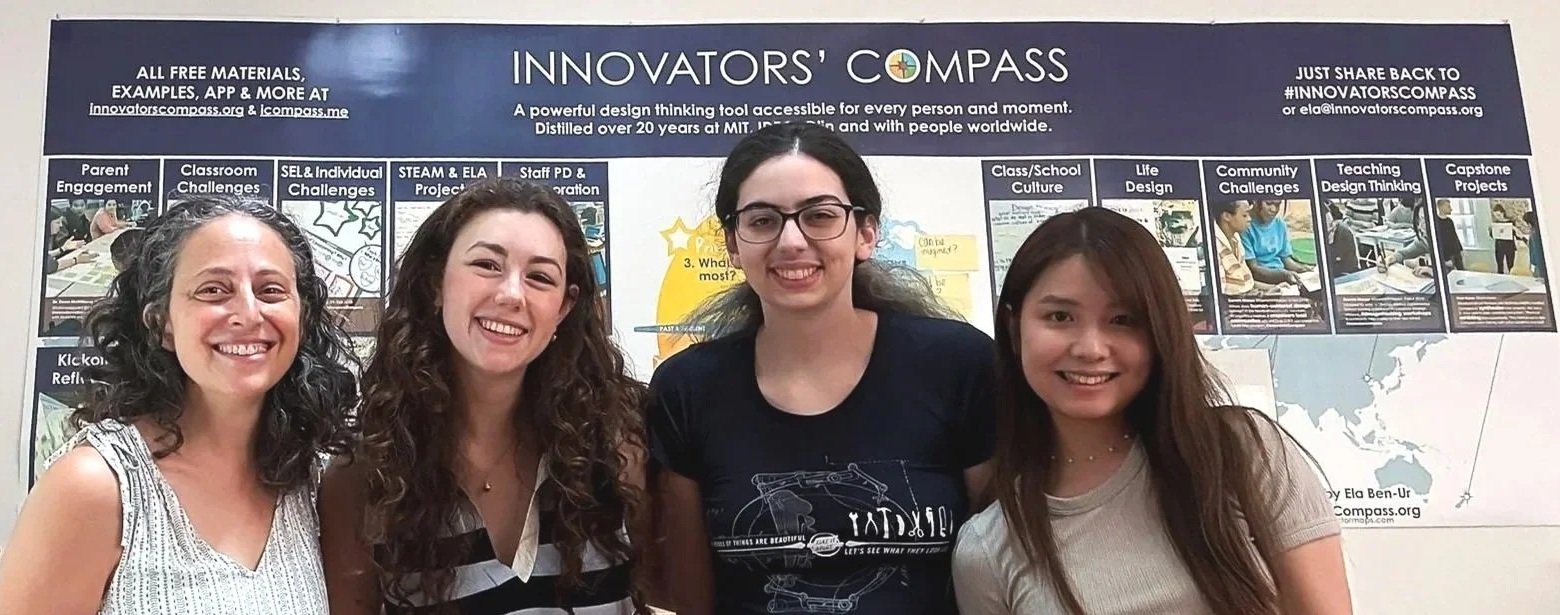
From right to left, Ziqi (Kiki) Cheng, Melissa Anthony, Nina Mindel, and myself (Ela Ben-Ur).
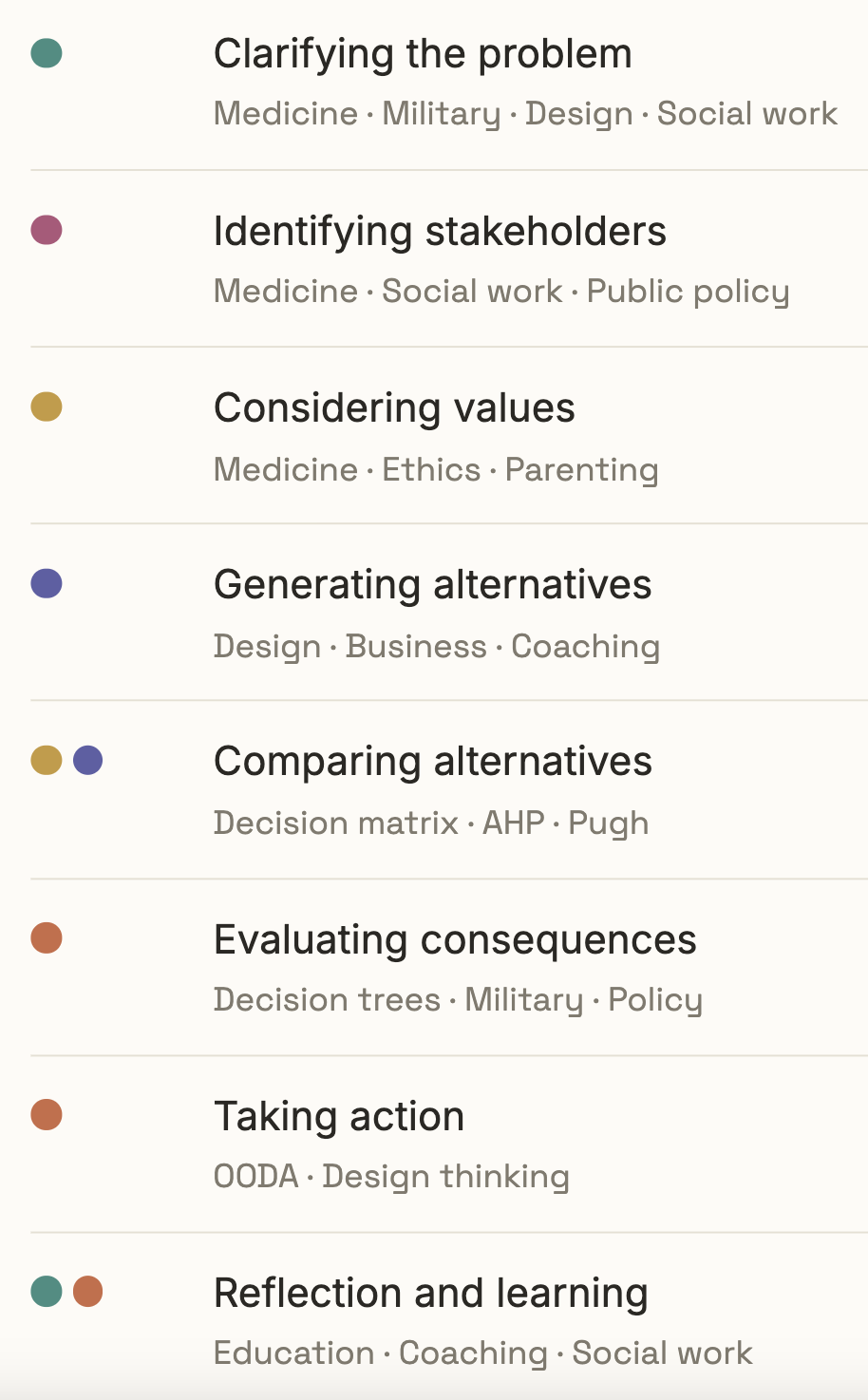
Ziqi (Kiki) Cheng used AI-assisted analysis to extend the range of my personal synthesis to-date, looking across dozens of decision-making and problem-solving tools and practices across disciplines—from military and medicine to design, social work, and systems thinking. She mapped their common and divergent patterns in several ways, exploring what different practices prioritize, where they overlap, and where they differ. This chart shows one simple view of those patterns.
With the colored dots, Kiki refers to where the Innovators’ Compass questions lie. Interestingly, the step of “comparing alternatives” — the final decision “moment” that most decision tools/matrices focus on—looks a bit hidden in the Innovators’ Compass right now. However….(see Melissa’s work below!).
Melissa Anthony explored decision research, including major branches around predicting probabilities of risks and outcomes, and detailing ways where, in natural decision-making, “people disagree with the math” in Melissa’s words.
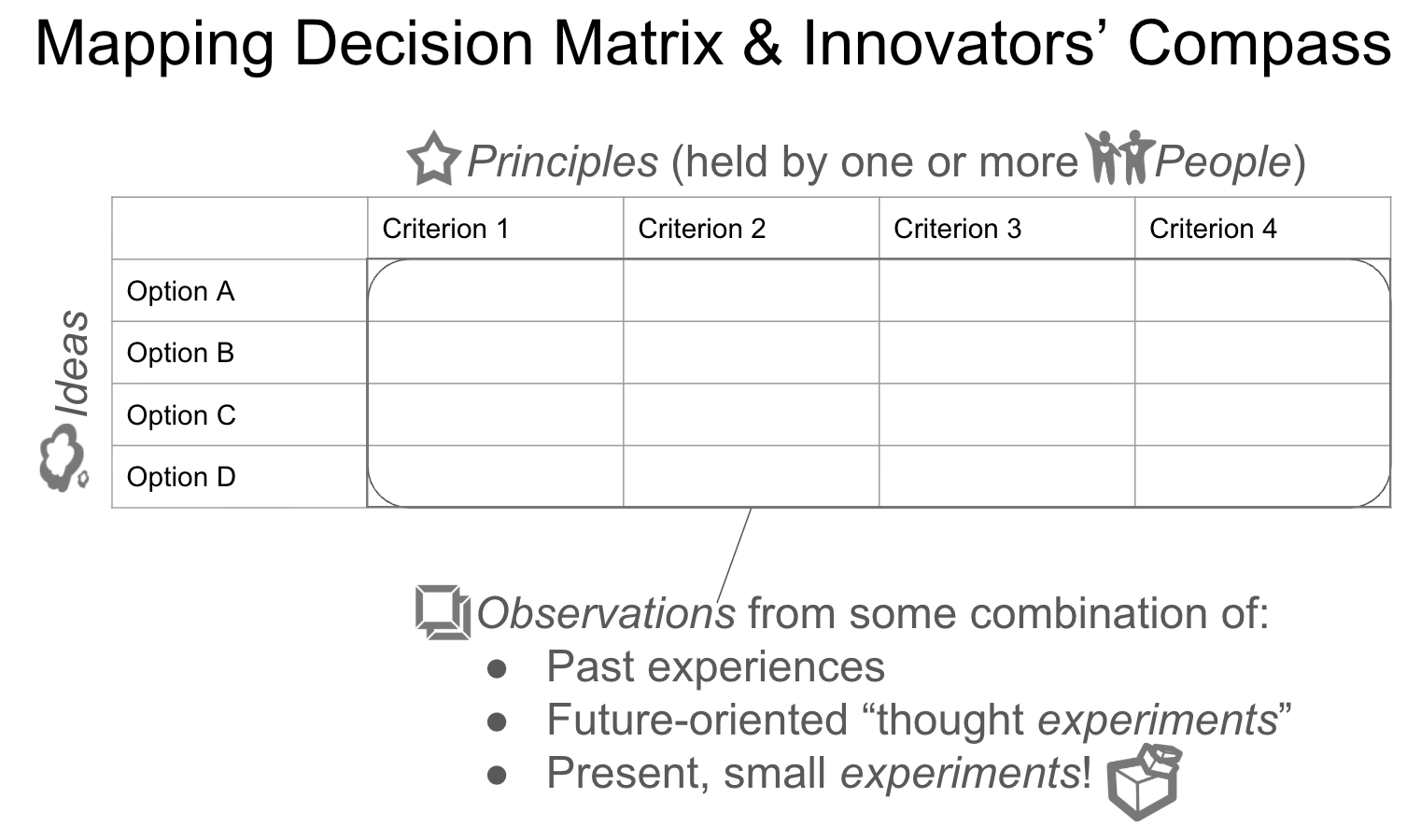
We found it fascinating to consider that Compass questions remix as a traditional “decision matrix.” Where these are usually filled out with observations based on past experiences or future-predicting “thought experiments,” the Compass complements these with observations from real, small experiments around one or more of the ideas/options.
Nina Mindel suggested we compare the established fields of “decision making” and “problem-solving.” Whether they explicitly name it or not, problem-solving practices, including my background field of design, involve making many decisions. They take decisions quite seriously, in their own way: they consider the full decision-making journey, beginning from understanding the situation, framing the challenges to be navigated and principles to guide their path (decisions!), generating options, then generating more options when those available aren’t great, experimenting with one or more options before deciding, and checking that the decision scales with the design.
With their work above, I took windows away from writing to explore further. For example, I was intrigued by practices across cultures and history:
From Jesuit Ignatian to Buddhist practices: slowing down to cultivate detachment and identify decisions that produce a sustained sense of peace.
From ancient Greek Dialectics to Taoist principles: embracing, learning from, and questioning contradictions (in our thinking, challenges, and the world).
Some of these historic perspectives come together in this interesting continuum from Systems Thinker Russell Ackoff, who stated "There are four ways of treating problems:”
1. Absolution: "To absolve a problem is to ignore it and hope it will go away or solve itself."2. Resolution: "To resolve a problem is to do something that yields an outcome that is good enough, that satisfies."
3. Solution: "To solve a problem is to do something that yields the best possible outcome, that optimizes.” "Problem solvers rely heavily on experimentation and analysis."4. Dissolution:" To dissolve a problem is to eliminate it by redesigning the system that has it [such that the problem no longer exists].” "Problem dissolvers try to idealize—to approximate an ideal system—and thereby do better in the future than the best that can be done now."
Defined by Decisions? Redefining Decisions? Both? Neither?
I’m not certain whether we’ll define these tools exclusively by the word “decision”. However, it’s clearer than ever that this would present a chicken-and-egg need/opportunity to not only help individuals and groups come to effective decisions and solutions sooner, when called for, but to open everyday modern professional expectations around “decisions”:
Opening the process well before/after the moment of “decision” closure
Opening the possibilities we consider beyond an existing set of options
Opening the information we consider beyond previously-known data
Opening compromise and competition to creativity and collaboration
Opening the inspiration from the extensive modern “decision” research and tools to decision-making perspectives, explicitly named or not, across practices and philosophies from antiquity to modernity.
Regardless, Points of Inspiration for These Tools and Book
Over all these years, I’ve drawn inspiration from every new person, process, and pracice I encounter. I’m excited about points that this work has encouraged me to bring out more in the tools and book, for example:
The complementary strengths of the “10+ human tools” we have in making decisions: from analytical thinking to weigh criteria or assess probabilities, to our hands and things around us to try real-life experiments, to our hearts at the center of the Compass.
Actively seeking to discover contradicting viewpoints—to help us put even more, productive, ? marks on our first thoughts toward better outcomes.
Practical ways to make decisions more inclusive of people involved
The importance of relationship and trust-building over time
Again, huge thanks to this curious, creative team and all the inspiration they netted this summer!